
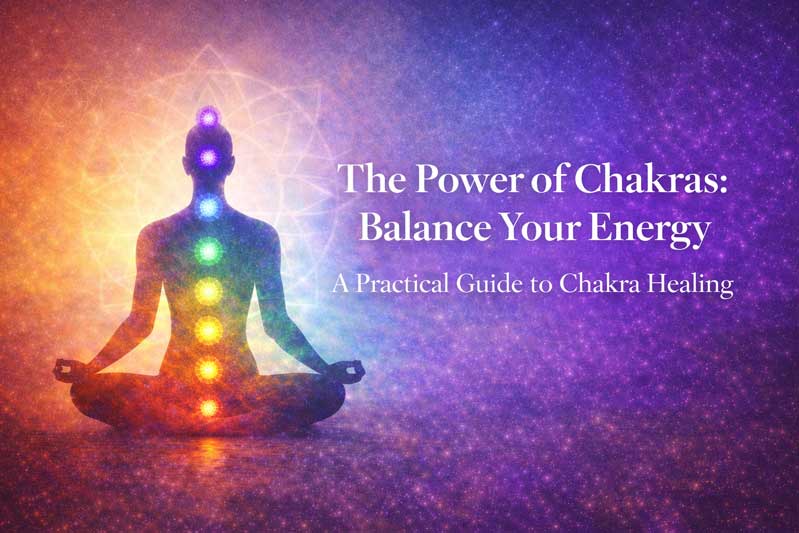
The Power of Chakras: Balance Your Energy – A Practical Guide to Chakra Healing
Key Takeaways
Chakras are energy centers that influence emotional stability, mental clarity, confidence, communication, and life direction.
Imbalanced chakras manifest as anxiety, overthinking, emotional instability, low confidence, and relationship patterns.
Chakra healing works by combining breathwork, awareness, behavioral correction, nervous system regulation, and environmental alignment.
A structured 7-day reset and 30-day practice can rewire emotional and behavioral patterns.
Chakra work is not mystical fantasy — it is a practical self-regulation framework integrating psychology, somatic awareness, and discipline.
Read a deatiled book on chakras : The Power Of Chakras: Balance Your Energy: A Practical Guide to Chakra Healing click here
Why Is Chakra Healing Suddenly Trending Again?
If you search for “chakra healing,” “energy alignment,” or “how to balance chakras,” you’ll notice a surge in interest.
But this isn’t just spiritual curiosity.
It’s a response to:
Rising anxiety levels
Chronic stress culture
Emotional burnout
Information overload
Disconnection from purpose
Modern life overstimulates the mind and under-regulates the nervous system.
Chakra healing is re-emerging because people are looking for practical internal stability — not just motivation.
And here’s what most blogs miss:
Chakras are not about mystical symbolism.
They are a framework for understanding:
Emotional regulation
Identity formation
Stress response patterns
Behavioral loops
Self-awareness architecture
Let’s break it down properly.
What Are Chakras — Really?
The word “chakra” means “wheel” in Sanskrit. Traditionally, chakras are described as spinning energy centers along the spine.
But from a modern lens, they can be understood as:
Psychophysiological regulation hubs.
Each chakra corresponds to:
Emotional themes
Hormonal influence
Nervous system response
Behavioral tendencies
Psychological identity patterns
Here’s a simplified comparison:
| Chakra | Emotional Theme | Imbalance Looks Like | Regulation Strategy |
|---|---|---|---|
| Root | Safety & Stability | Anxiety, money fear | Grounding & breath |
| Sacral | Emotion & Pleasure | Mood swings, guilt | Emotional release |
| Solar Plexus | Confidence & Power | Procrastination | Action discipline |
| Heart | Love & Trust | Resentment | Forgiveness work |
| Throat | Expression | Suppression | Clear boundaries |
| Third Eye | Clarity | Overthinking | Silent awareness |
| Crown | Purpose | Disconnection | Value alignment |
This isn’t abstract mysticism.
It’s a structured map of internal experience.
How Do You Know If Your Chakras Are Blocked?
Let’s humanize this.
Case Study: “Ananya”
Ananya is successful on paper. Stable career. Good income.
But she constantly feels:
Financial anxiety (Root imbalance)
Emotional dependency in relationships (Sacral imbalance)
Fear of speaking up in meetings (Throat imbalance)
Externally, she looks stable.
Internally, her energy system is fragmented.
This is how chakra imbalance appears in real life:
Anxiety without immediate threat
Repeating relationship patterns
Low self-esteem despite competence
Chronic overthinking
Emotional numbness
Lack of long-term direction
The symptoms are psychological.
The framework to regulate them is energetic.
Is There Scientific Logic Behind Chakra Healing?
Let’s address skepticism intelligently.
Chakra work overlaps with:
Polyvagal Theory (nervous system regulation)
Somatic psychology (body-stored emotion)
Cognitive Behavioral loops
Neuroplasticity research
Breathwork-induced parasympathetic activation
For example:
Slow breathing with extended exhale has been shown to reduce cortisol levels and activate parasympathetic calming responses.
Grounding practices improve emotional stability.
Journaling reduces rumination.
Posture influences confidence hormones.
Chakra healing integrates all of these — under one behavioral structure.
That’s the real power.
How Do You Balance Your Chakras Practically?
Here’s where most blogs fail.
They say:
“Visualize colors.”
But visualization alone does not rewire behavior.
Here’s a structured 7-Step Chakra Reset Framework:
Step 1: Stabilize Safety (Root)
Slow breathing (4-4-6 rhythm)
Financial awareness ritual
Physical decluttering
Pro Tip: Clean your immediate workspace before doing emotional work.
Step 2: Release Emotional Stagnation (Sacral)
10-minute uncensored journaling
Allow emotion labeling
Engage in one pleasurable activity daily
Emotions ignored become behavioral triggers.
Step 3: Build Inner Authority (Solar Plexus)
Take one uncomfortable action daily
Set one boundary
Maintain posture discipline
Confidence is built through repeated action — not affirmations alone.
Step 4: Repair Connection (Heart)
Practice forgiveness journaling
Gratitude habit
Heart-coherence breathing
Emotional balance requires conscious compassion.
Step 5: Strengthen Expression (Throat)
Speak one honest statement daily
Stop over-explaining
Hum or vocalize tension
Truth spoken reduces resentment accumulation.
Step 6: Clear Mental Fog (Third Eye)
5-minute silent sitting
Reduce unnecessary digital input
Quick intuitive decisions
Clarity requires mental space.
Step 7: Align With Meaning (Crown)
Reflect on values weekly
Ask: “Why am I doing this?”
Maintain gratitude practice
Purpose reduces chronic anxiety.
Can Chakra Healing Reduce Anxiety?
Short answer: Yes — when applied practically.
Root regulation directly impacts anxiety patterns.
Anxiety is often:
Fear without immediate threat.
Root work teaches the nervous system safety through:
Breath
Physical grounding
Environmental order
Financial clarity
Consistency is key.
Five minutes daily over 30 days produces measurable calmness.
Buy chakra painting click here
How Long Does It Take to See Results?
In practical application:
7 days → Increased awareness
14 days → Noticeable emotional regulation
30 days → Behavioral shifts
60 days → Identity stabilization
Neuroplastic change requires repetition.
Chakra healing is not instant.
It is disciplined.
Frequently Asked Questions
What is the most powerful chakra?
The most foundational chakra is the Root, as safety regulates all other centers.
Can you balance chakras yourself?
Yes, through daily breathwork, awareness, and disciplined behavioral alignment.
Are chakras scientifically proven?
While chakras themselves are spiritual constructs, many practices used in chakra healing align with established psychological and physiological regulation methods.
Which chakra causes anxiety?
Primarily the Root Chakra when safety feels unstable.
How often should I practice chakra healing?
Daily micro-practices (5–10 minutes) are most effective.
Do chakras really affect relationships?
Yes, especially the Sacral, Heart, and Throat centers.
Final Perspective: Energy Is Identity
You are not broken.
You are patterned.
Patterns are regulated through awareness and repetition.
Chakra healing works when:
You combine breath + behavior
You regulate emotion instead of suppressing it
You build discipline instead of waiting for motivation
You align action with values
Balance is not mystical.
It is maintained.
Comments : (0)