
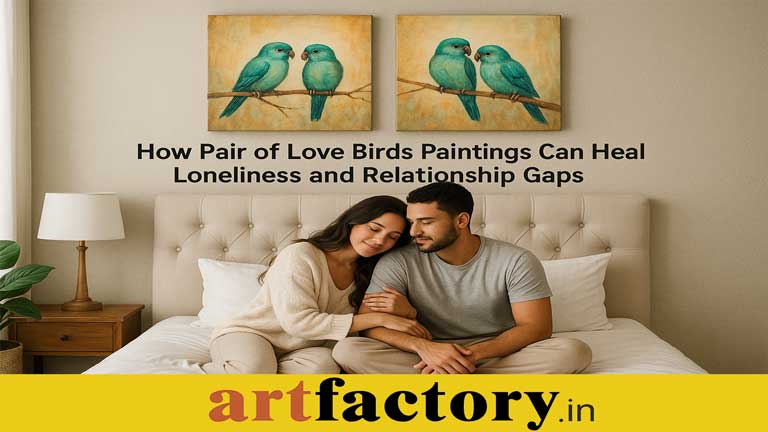
How Pair of Love Birds Paintings Can Heal Loneliness and Relationship Gaps
Introduction
Loneliness and emotional distance often stem from subtle energetic imbalances in our living spaces. The good news: a well-chosen painting—a pair of love birds—can act as a powerful remedy. In both Vastu Shastra and Feng Shui, this imagery symbolises unity, commitment and affectionate energy. When placed with intention in the correct sector of your home, the painting becomes a beacon of connection, inviting love, intimacy and togetherness to fill the gaps. This blog thoroughly explains why and how a pair of love birds painting heals loneliness and relationship gaps—complete with direction-based placement, psychological effects, décor tips, and FAQs.
1. Why a “Pair of Love Birds” Painting Works for Emotional Healing
1.1 Symbolism of Togetherness
The motif of two birds perched side by side naturally evokes partnership, companionship, mutual support, and communication. In Vastu and Feng Shui lore, birds flying or perched together represent harmonious union and joint energy-flow, not solitary isolation. The image anchors the idea: “You are not alone.”
1.2 Energetic Alignment in the Home
In the art of spatial energy, visuals are not just décor—they carry chi (life-force). When you place a painting of love birds in the South-West (SW) corner of your bedroom or living area—the zone traditionally associated with relationships and marital bonds—you activate the marriage/partnership element. artfactory.in+2The Times of India+2
This activation can gently shift the environment from isolation to invitation, enabling better emotional connection.
1.3 Psychological Impact on Mindset
Art influences mood, beliefs and internal narrative. When you live with an image of togetherness, your subconscious mind receives cues of unity. This aligns your thoughts toward openness, vulnerability and healing rather than withdrawal and loneliness. It's a subtle yet powerful shift.
1.4 Bridging Relationship Gaps
Whether you’re in a relationship and feel distance, or you’re single and longing for connection, the painting works on both levels. For couples it fosters harmonising the bond; for singles it signals readiness for healthy partnership. As one Vastu article notes: “One of the most common symbols for love and harmony is a pair of lovebirds or swans… placing them in the southwest corner of your bedroom promotes harmony between partners.” The Times of India
2. Ideal Placement: Direction, Room & Height
2.1 Best Direction – South-West (SW)
For relationships, marriage, emotional healing, the South-West zone of your home is key. Position the painting on the South wall of your bedroom or on the South-West wall of your living room for maximum effect. This aligns the directional energy of the zone of “earth/partner” element.
2.2 Secondary Placement – North-West (NW) for Social & Emotional Support
If loneliness is more about social isolation or lack of friends/family connection, the North-West direction supports helpful people, social circles, emotional outreach. A pair-birds painting here can invite friendly warmth and emotional openness.
2.3 Room & Surface Considerations
Bedroom: Hang above the headboard or on the wall facing the bed (SW side).
Living room: Use the SW or NW wall as above, at an eye-level height (approx. 150-170 cm from floor).
Avoid placing the painting in bathrooms, kitchens, or directly opposite the door, as energy may remain unsettled.
2.4 Height, Frame & Style Tips
Choose a moderately sized canvas (not too small—so it’s noticed; not too large—so it doesn’t dominate). A clean frame (wood or soft neutral) supports calm energy. Ensure the birds appear as a cohesive pair—no one bird flying away alone. The gaze of the birds ideally faces into the room, not out the window (which symbolises leaving).
3. Visual Characteristics & Colours That Strengthen Connection
3.1 Birds in Pair, Intimate Pose
Select artwork depicting two birds side by side, touching beaks or close to each other. This communicates mutual support and closeness.
3.2 Soothing, Warm Colour Palette
Choose warm-toned backgrounds—gentle rosé, soft peach, pastel yellow, blush— to enhance emotional softness. The bodies of the birds may include subtle colours: light blue for calm, rose or coral for love. This balances passive harmony and active connection.
3.3 Background Symbolism
A background of blooming branches, gentle skies or trees signifies growth together. Avoid harsh modern abstractions for this purpose; you want a gentle, emotionally evocative scene.
3.4 Framing & Materials
Use a simple border that doesn’t distract. Natural wood or muted metallic frames work. Canvas is preferred (for depth) but a fine-print under glass is acceptable. Ensure the artwork is clean, undamaged, and you treat it with respect—cleaning it lightly helps maintain positive vibes.
4. How to Activate & Support Healing Through the Painting
4.1 Intention Setting
When you hang the painting, spend a few minutes in front of it. Visualise your loneliness or relationship gap dissolving. Imagine love, connection, warmth entering. State an affirmation like: “I invite connection, togetherness and emotional healing into this space.”
4.2 Daily Engagement
Make it part of your morning or evening routine: glance at the painting, greet it mentally, express gratitude for the love you already have or will receive. Consistent acknowledgment keeps the energy alive.
4.3 Enhance with Complementary Elements
Place fresh flowers near the painting—flowers invite life and energy.
Use a soft lamp or candle nearby to infuse warmth.
Avoid clutter around the frame; keep the space clean to allow energy flow.
4.4 Avoiding Negative Placement
Do not hang the painting where one bird appears to be flying away or perched alone—this could symbolise separation.
Avoid placing behind a headboard where you cannot see it; you want conscious and subconscious awareness of the imagery.
Don’t bury it behind large furniture or in darkness—engagement with the image matters.
5. Healing Loneliness: Single, Divorced or Separated
If you’re single or coming out of a relationship, this painting becomes a beacon of hope, not simply décor.
5.1 Reframe the Narrative
By placing this painting you’re sending a message—not “I’m alone,” but “I’m open to connection.” That shift in your personal space helps shift your mindset.
5.2 Create Parallel Real-Life Actions
Hang the painting and engage socially—invite close friends, join groups, reconnect family. The painting supports you; you take the steps.
As one article notes: “Artwork can significantly influence the mood of a space… matching pieces featuring couples or togetherness are particularly powerful.” The Times of India+1
5.3 Balance Patience and Openness
The remedy is subtle, not instant. Maintain open heart-energy rather than desperation energy. The painting reinforces patience, self-respect and alignment with the quality of relationship you deserve.
6. Bridging Relationship Gaps: Couples, Long-Distance, Emotional Disconnect
6.1 Strengthen Emotional Bridge
For couples experiencing distance (emotionally or physically), the painting acts as a reminder of cooperation, togetherness, shared journey. It invites gentle reconnection.
6.2 Long-Distance, Frequent Travel or Busy Schedules
If you’re apart often or emotionally disconnected because of work/stress, place the painting in a communal space or your bedroom to anchor the relationship energy when you’re together and when you’re apart.
6.3 Communication Booster
Make the act of looking into the painting together a ritual—sit side by side, hold hands, reflect on the painting and what you both wish for in relationship. It becomes a shared visual anchor.
6.4 Vastu Energy Check
Ensure the couple’s bedroom and its SW zone are uncluttered, electronics are minimal (to avoid disruption of peaceful energy) as recommended by Vastu experts. Architectural Digest India
Explore our entire collection on love and relationship click here
7. FAQs
Q1: Can a painting of love birds really improve my relationship?
A1: Yes — when you choose a visual of a pair of love birds and hang it in the correct direction (typically the South-West zone), you create a symbolic and energetic anchor of partnership and affection. This supports emotional connection, shifts mindset from isolation to union, and complements other relationship-care practices.
Q2: Where should I hang the love birds painting for maximum effect?
A2: The most effective placement is on the South wall of your bedroom or the South-West wall of your shared space. Ensure the painting is visible from where you sit or rest, at a comfortable eye level, uncluttered and well-lit. The space should feel calm and inviting for the partnership energy to flow.
Q3: I’m single and feeling lonely — will this painting work for me too?
A3: Absolutely. For singles, the painting of a pair signals readiness for respectful partnership rather than desperation. Place it in your own space’s North-West or South-West corner, engage socially, and allow the painting to anchor the intention of healthy connection coming into your life.
Q4: What colour and style should the painting be for emotional healing?
A4: Choose a style showing two birds together, ideally with gentle interaction (touching beaks, perched close). Use warm pastel tones—pink, blush, peach or soft corals—for emotional warmth; soft blues or greens for calm. Avoid stark, aggressive modern abstractions as they may disrupt the soothing energy.
Q5: Can the painting fix major relationship issues alone?
A5: The painting is a supportive tool, not a magic wand. It boosts energy alignment and emotional openness, but active communication, trust-building, therapy (if needed) and personal growth remain necessary. Think of the painting as a friendly reminder and space-enhancer, not the sole solution.
Q6: Should I replace the painting after a few years?
A6: If the painting remains intact, clean, and emotionally resonant, you can keep it indefinitely. However, if the image begins to feel stale, detached or unaligned with your current emotional phase, replacing it with a new one that reflects your evolving relationship or emotional state is beneficial.
8. Real-Life Case Study (Hypothetical Example)
Scenario: A couple working long hours and drifting emotionally felt a gap. They hung a painting of two love birds on the South-West wall of their bedroom, at 160 cm height, with the birds facing into the room. They used a soft blush-peach background image and introduced a weekly “look at our painting together and share one appreciation” ritual.
Outcome: Within six weeks, they reported more meaningful conversation, less performance mode and a renewed sense of “we” rather than “me and you”. The painting acted as a visual anchor and catalyst for reconnection.
9. Practical Checklist for Implementation
Choose a painting depicting two birds together, calm and harmonious.
Decide on placement: South wall (bedroom) or South-West wall (living area).
Ensure height is comfortable (~150-170 cm from floor) and free from obstructions.
Clean the wall and surrounding area—declutter, ensure light and decent space.
Set an intention when hanging: speak aloud what you wish to invite (connection, love, companionship).
Create a simple routine—glance daily, express gratitude, share moments with partner if relevant.
Complement with fresh flowers, soft lighting; avoid harsh colours or heavy electronics nearby.
Review energy after 3-6 months: does the painting still feel relevant? Do you sense improvement in connection or solitude? If yes—continue. If no—consider whether behavioural support is also needed.
10. Summary: Transform Your Space, Transform Your Heart
In essence, the humble pair of love birds painting is a potent tool—when used with intention and aligned with Vastu and Feng Shui principles—it becomes a visual mantra for togetherness, connection and emotional healing. Whether you seek to move out of loneliness, connect deeper with a partner, or elevate your space’s energy for love to flow, this painting offers a bridge between your internal state and spatial energy. Use it wisely, align it correctly, engage with it meaningfully—and watch as your space begins to reflect the relationships you long for.
Comments : (0)