
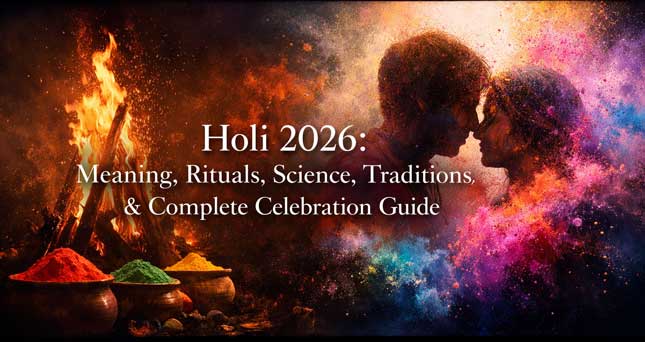
Holi 2026: Meaning, Rituals, Science, Traditions & Complete Celebration Guide
Key Takeaways
Holi 2026 Holika Dahan will be observed on 2 March 2026, while Holi celebrations (Rangwali Holi) will take place on 3 March 2026, and in some regions extend to 4 March 2026.
Holi symbolizes the victory of good over evil, spiritual cleansing, emotional renewal, and the arrival of spring.
Rooted in the story of Prahlada and Holika, and inspired by the divine play of Krishna and Radha, Holi blends devotion and joy.
Celebrated across India and globally, Holi varies regionally—from Lathmar Holi in Barsana to Hola Mohalla in Punjab.
Eco-friendly colors, consent-based celebration, and mindful rituals make Holi relevant for modern families worldwide.
Holi is not just a festival—it is a social reset, emotional detox, and cultural unifier.
What Is Holi and Why Is It Celebrated?
Holi is one of India’s most vibrant and emotionally expressive festivals. Known as the “Festival of Colors,” it marks the end of winter and the arrival of spring, symbolizing renewal, joy, forgiveness, and unity.
At its core, Holi represents:
Burning negativity and ego
Restoring broken relationships
Celebrating equality
Welcoming abundance and new beginnings
Unlike many formal festivals, Holi dissolves social boundaries. On this day, age, status, and hierarchy fade into laughter and color.
When Is Holi in 2026?
In 2026, the celebration unfolds as follows:
Holika Dahan: 2 March 2026 (Monday night)
Rangwali Holi / Dhulandi: 3 March 2026 (Tuesday)
Extended Celebrations (Rang Panchami / regional observances): 4 March 2026 (Wednesday in some regions)
The festival falls on the Full Moon (Purnima) of the Hindu month of Phalguna.
Why Two or Three Days?
Holi traditionally spans multiple days:
Holika Dahan (Night Ritual) – Spiritual cleansing
Color Celebration (Main Day) – Joyful expression
Regional Extensions (Rang Panchami, temple celebrations, community gatherings)
Some states continue color celebrations on the fifth day after the full moon, known as Rang Panchami.
What Is the Story Behind Holi?
The Spiritual Foundation: Prahlada and Holika
The origin of Holi is rooted in ancient Hindu mythology.
King Hiranyakashipu demanded to be worshipped as supreme. His son Prahlada refused and remained devoted to Lord Vishnu. In an attempt to kill him, Holika—who had a boon protecting her from fire—sat with Prahlada in flames.
Divine justice prevailed.
Holika burned, Prahlada survived.
This event symbolizes:
Faith over fear
Truth over tyranny
Devotion over ego
The bonfire of Holika Dahan (2 March 2026) commemorates this moment.
Families gather around the fire, offer grains and coconuts, and symbolically release negativity.
The Celebration of Divine Love: Krishna and Radha
Holi is also deeply connected with the playful legends of Krishna and Radha in Vrindavan.
It is believed Krishna applied color to Radha playfully, beginning a tradition that evolved into today’s color festival.
In Mathura and Vrindavan, Holi is not merely festive—it is devotional and theatrical, often celebrated for several days.
How Is Holi Celebrated Across India in 2026?
Holi adapts beautifully across regions.
| Region | Celebration Style | Special Feature |
|---|---|---|
| Barsana & Mathura | Lathmar Holi | Women playfully hit men with sticks |
| West Bengal | Dol Jatra | Processions with Krishna idols |
| Punjab | Hola Mohalla | Martial arts and Sikh warrior displays |
| Maharashtra | Rang Panchami (4 March 2026) | Extended color celebrations |
| Rajasthan | Royal Holi | Traditional palace gatherings |
In 2026, some areas will celebrate colors on 3 March, while others extend festivities to 4 March.
What Happens on Holika Dahan (2 March 2026)?
Holika Dahan is the spiritual heart of Holi.
Ritual Significance:
Lighting the sacred bonfire
Chanting prayers
Offering harvest grains
Circumambulating the fire
Symbolic Meaning:
The fire represents burning:
Ego
Anger
Resentment
Toxic habits
Many families write down one negative trait and symbolically offer it into the flames.
It is a powerful psychological and spiritual reset.
What Happens on 3 March 2026 – The Main Holi Celebration?
On this day:
Dry colors (gulal) are applied
Water balloons and pichkaris are used
Music and dance fill the streets
Families exchange sweets like gujiya and malpua
The atmosphere becomes playful and liberating.
In many modern housing societies, celebrations are organized with DJs, organic colors, and community lunches.
Why Do Some Places Celebrate on 4 March 2026?
Certain regions observe Rang Panchami, especially in Maharashtra and parts of Central India.
It occurs on the fifth day after the full moon and emphasizes:
Spiritual purification
Extended community bonding
Traditional temple celebrations
Thus, Holi in 2026 spans 2nd, 3rd, and 4th March in various locations.
What Is the Psychological and Scientific Significance of Holi?
Holi aligns with seasonal transition—from winter to spring.
Ancient communities used herbal colors made from:
Turmeric
Neem
Tesu flowers
Sandalwood
These ingredients had antimicrobial properties, supporting immunity during weather change.
From a psychological standpoint:
Collective celebration reduces stress
Playfulness strengthens social bonds
Ritual closure improves emotional well-being
In a digitally isolated era, Holi reactivates real-world human connection.
How to Celebrate Holi 2026 Mindfully? (Step-by-Step Guide)
Step 1: Prepare Spiritually (Before 2 March)
Reflect on what you want to release in Holika Dahan.
Step 2: Attend Holika Dahan (2 March Night)
Offer gratitude and symbolic negativity into the fire.
Step 3: Choose Safe Colors (3 March)
Use organic, skin-friendly powders.
Step 4: Protect Your Skin
Apply oil before playing.
Step 5: Respect Consent
Ask before applying colors.
Step 6: Celebrate Community
Share food, laughter, and reconciliation.
Step 7: Continue with Gratitude (4 March if observed)
Use extended celebration for reconnecting with elders and community members.
How Is Holi Celebrated Globally?
Holi is celebrated widely in:
United Kingdom
United States
Canada
Australia
UAE
International events often blend Indian tradition with live music festivals.
However, the spiritual essence remains the same—celebrating renewal and unity.
What Makes Holi Unique Compared to Other Festivals?
| Festival | Central Theme | Mode of Celebration |
|---|---|---|
| Diwali | Light over darkness | Lamps & fireworks |
| Navratri | Divine feminine energy | Fasting & Garba |
| Raksha Bandhan | Sibling bond | Sacred thread ritual |
| Holi | Emotional renewal | Colors & collective play |
Holi uniquely encourages playful equality and spontaneous joy.
A Real-Life Modern Example: Community Holi 2025 Case Study
In a gated society in Pune:
Past Holi events led to complaints about water wastage and misconduct.
Organizers introduced organic colors, dry Holi zones, and family-only timing.
Holika Dahan was performed with collective intention writing.
Result:
Participation increased 70%.
Zero complaints.
Higher neighbor interaction scores in post-event surveys.
When structured consciously, Holi strengthens communities.
Frequently Asked Questions
When is Holika Dahan in 2026?
Holika Dahan is on 2 March 2026.
When is Holi in 2026?
Main Holi celebration is on 3 March 2026, with some regions celebrating on 4 March as well.
Why is Holi celebrated?
To mark the victory of good over evil and welcome spring.
What does Holika Dahan symbolize?
Burning negativity and ego.
Is Holi celebrated worldwide?
Yes, across many countries with Indian communities.
What are natural Holi colors made from?
Turmeric, flowers, herbs, and plant-based powders.
Why Holi 2026 Is More Relevant Than Ever
In 2026, as people seek connection in a hyper-digital world, Holi offers:
Emotional healing
Community bonding
Cultural pride
Seasonal renewal
It is not merely a festival—it is a collective reset.
Celebrate consciously on:
2 March 2026 – Release negativity
3 March 2026 – Embrace joy
4 March 2026 – Strengthen bonds (in applicable regions)
Comments : (0)