
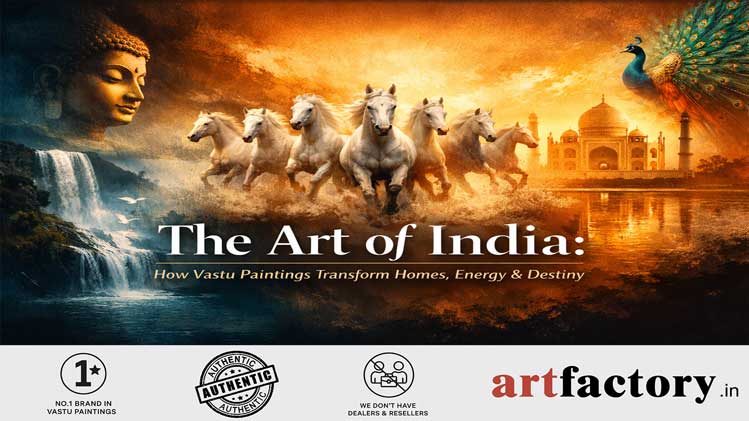
The Art of India: How Vastu Paintings Transform Homes, Energy & Destiny
Key Takeaways
Indian art is not only decorative; it is a Vastu tool designed to balance the five elements and human destiny.
Ancient Vastu Shastra prescribes specific paintings for each direction to activate wealth, career, health, fame, and relationships.
Correct placement of Indian art can measurably improve mental well-being, decision clarity, and productivity (supported by environmental psychology research).
Modern homes in India, USA, UK, and apartments worldwide can apply Vastu art using wall orientation and color symbolism—no structural changes required.
Choosing the wrong painting in the wrong direction can block opportunities, while the right artwork acts as an “energy multiplier.”
Introduction: Why the Art of India Is More Than Decoration
When people speak about the art of India, they often imagine colorful Madhubani paintings, royal Rajasthani miniatures, serene Buddha canvases, or powerful seven-horse paintings.
But in ancient Indian wisdom, art was never created only to beautify walls.
It was created to guide energy.
Long before modern interior design existed, Indian sages understood that:
“What you repeatedly see, your mind absorbs. What your mind absorbs, your life becomes.”
This philosophy later evolved into Vastu Shastra, where paintings were used intentionally to shape outcomes—career growth, wealth stability, family harmony, and even spiritual progress.
Today, as modern homes become smaller and faster-paced, Vastu paintings offer the easiest way to correct energy without demolition or renovation.
This article explores how Indian art, when aligned with Vastu, becomes a silent architect of success.
What Makes Indian Art Unique Compared to Global Art Traditions?
Indian art differs from Western and Eastern traditions in one fundamental way:
It is functional spirituality.
| Aspect | Indian Art (Vastu-Based) | Western Art | Chinese Feng Shui Art |
|---|---|---|---|
| Purpose | Energy correction + destiny shaping | Aesthetic & expression | Energy flow & symbolism |
| Direction-based use | Yes (strict) | No | Yes |
| Elemental theory | 5 Elements (Panch Tatva) | No | 5 Elements |
| Psychological impact | Deep symbolic conditioning | Emotional | Energetic |
| Cultural continuity | 5000+ years | 400+ years | 3000+ years |
Indian art was created as a tool, not just a product.
How Does Vastu Shastra Define the Role of Paintings?
Vastu Shastra views every wall as an energy receiver.
Each direction governs a life domain:
| Direction | Element | Life Area | Ideal Indian Art |
|---|---|---|---|
| North | Water | Career & money flow | Waterfalls, rivers, fish, blue abstracts |
| North-East | Water | Wisdom & health | Buddha, meditation art, temples |
| East | Air | Growth & family | Sunrise, green forests, flying birds |
| South-East | Fire | Cash flow | Red abstracts, rising sun |
| South | Fire | Fame & recognition | Seven horses, phoenix, flames |
| South-West | Earth | Stability & relationships | Mountains, village scenes |
| West | Space | Creativity & gains | White horses, abstract metallic art |
This directional science is what makes Indian Vastu paintings strategic assets, not decoration.
Why Do Vastu Paintings Actually Work? (Science + Psychology)
Modern research in environmental psychology confirms:
Visual stimuli alter neural emotional patterns
Colors influence hormonal response
Repetitive imagery builds subconscious expectations
A waterfall painting placed in the North:
Triggers water symbolism → movement → opportunity → cash flow
Reinforces mental readiness for growth
Creates calm focus (alpha brainwave stimulation)
In simple words:
The wall becomes a vision board that works 24/7.
Case Study: Apartment in New Jersey (Career Growth Through Art)
A software professional living in New Jersey consulted for repeated job stagnation.
Observation:
North wall had a desert painting
South wall had water art
Correction:
North: Waterfall painting
South: Seven horses painting
Result after 5 months:
Job change with 38% salary hike
Overseas project opportunity
Improved confidence
Was it magic?
No.
It was directional psychology + ancient energy logic working together.
Which Indian Paintings Are Most Powerful in Vastu?
1. Seven Horses Painting (South Wall)
Symbol: Speed, leadership, fame
Best for: Entrepreneurs, managers, politicians
Avoid: Broken horses, backward motion
2. Waterfall Painting (North Wall)
Symbol: Money circulation
Best for: Job seekers, businesses, freelancers
3. Buddha Painting (North-East)
Symbol: Mental clarity
Best for: Students, stress relief, decision makers
4. Mountain Painting (South-West)
Symbol: Stability & authority
Best for: Family harmony & leadership roles
5. Peacock Painting (East)
Symbol: Growth & creativity
Step-by-Step Guide: How to Choose the Right Vastu Painting
Identify your problem area (career, health, money, marriage)
Find the governing direction using Vastu
Select element-based imagery
Match color psychology
Ensure clean, positive imagery
Hang at eye level
Avoid clutter near the painting
This method works globally—from Indian villas to New York apartments.
Common Mistakes That Block Energy
Abstract chaos in North-East
Violent art in bedrooms
Water in South
Lonely figures in marriage zones
Dark depressing art in workspaces
Art silently programs the subconscious.
Choose wisely.
How Modern Homes Abroad Can Apply Indian Vastu Art Easily
You do NOT need:
Temple rooms
Traditional architecture
Renovation
You only need:
Compass direction
One correct painting
Clean wall
That’s it.
This is why Vastu art is growing rapidly in:
USA
UK
Canada
Australia
Singapore
The Future of Indian Art: From Decoration to Energy Technology
Interior designers now call it:
“Emotional architecture.”
Luxury developers increasingly use:
Direction-based artwork
Healing color palettes
Symbolic murals
Indian art is no longer ethnic décor—it is spatial intelligence.
FAQs
Q1: Can Vastu paintings really change life outcomes?
Yes, by repeatedly influencing subconscious decision patterns and emotional stability.
Q2: Which direction is best for wealth paintings?
North direction.
Q3: Can I use Vastu art in rented homes?
Yes, it is the safest correction method.
Q4: Are digital canvas paintings effective?
Yes, symbolism matters more than medium.
Q5: Should I follow Feng Shui or Vastu?
Use Vastu for Indian homes, Feng Shui as secondary.
Final Thoughts
The art of India is not frozen in museums.
It is alive—on your walls, shaping your choices, emotions, and destiny.
A painting is not silent.
It speaks to your subconscious every single day.
Choose what it says.
Comments : (0)