
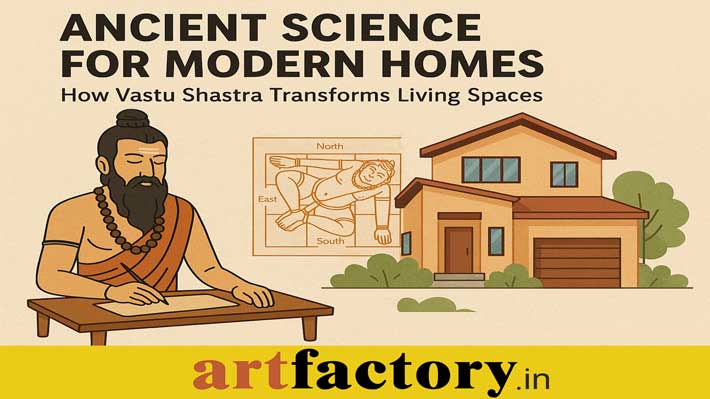
Ancient Science for Modern Homes: How Vastu Shastra Transforms Living Spaces
Why Ancient Wisdom Matters in Modern Homes
In today’s fast-paced world of concrete jungles, high-rise apartments, and modern architecture, one ancient science continues to hold relevance — Vastu Shastra. Often described as the "Yoga of architecture," Vastu blends architecture, design, energy, and natural elements to create harmony in living spaces.
But here’s the question most modern homeowners ask:
👉 Can an ancient Indian science really guide modern home design and make a tangible difference to health, wealth, and happiness?
The answer is YES. Vastu Shastra, though thousands of years old, is not outdated. It is a timeless science based on natural energies, directions, and the five elements — principles that are still valid in every home, whether in India, the USA, or Europe.
In this blog, we will explore how this ancient science can be applied to modern homes, why it is gaining worldwide popularity, and how adopting Vastu in design and décor is the key to balanced, prosperous living.
The Origin of Vastu Shastra: The Ancient Science of Space
Vastu Shastra, which literally translates to “Science of Dwelling”, originated over 5000 years ago. Ancient Indian sages observed how sunlight, wind, water flow, Earth’s magnetic field, and cosmic energy influence human life. These observations were codified into rules for construction, design, and spatial arrangement.
Some key foundations:
Directions (North, South, East, West, and intermediates) carry different energies.
Five Elements (Earth, Water, Fire, Air, Space) govern balance in nature.
Proportions, geometry, and energy flow dictate how a house affects its residents.
Interestingly, modern sciences like bioclimatic architecture and Feng Shui share similar principles, proving that Vastu is not superstition but a science rooted in nature.
Why Modern Homes Need Ancient Vastu Principles
Most modern homes and apartments are built without considering energy flow, natural light, or direction-based planning. As a result, people often face issues like:
Constant stress and lack of peace.
Financial blockages or job instability.
Health problems with no medical explanation.
Conflicts in relationships.
Vastu provides scientific solutions by harmonizing the home with universal energies. Unlike expensive renovations, even small Vastu corrections with décor, paintings, and placements can bring big changes.
For example:
A Seven Horses Painting on the North wall activates career growth.
A Waterfall painting in the North enhances opportunities and wealth.
A Mountain painting in the South gives stability and fame.
Why Vastu is Becoming Popular Across the World
Over the last few decades, Vastu has seen a tremendous rise in popularity not just in India but globally. Here are the reasons:
Increased Stress in Modern Life
With urbanization and fast-paced lifestyles, people are searching for ways to restore peace and balance. Vastu offers simple, non-religious, and practical solutions for stress-free living.Global Awareness of Holistic Sciences
Just like Yoga and Ayurveda became international movements, Vastu is now recognized as a holistic science of architecture that enhances life quality.Scientific Backing
Modern research into light, airflow, magnetic fields, and psychology of space supports what Vastu has been saying for thousands of years. For instance, homes facing the right directions get better sunlight, which improves health and mood.Easy Application in Modern Homes
Even if structural changes are not possible, Vastu can be applied with décor elements, paintings, and symbolic placements. This makes it accessible for people living in apartments across the USA, UK, Canada, and beyond.Testimonials and Success Stories
More and more homeowners, business owners, and professionals have shared real-life success after applying Vastu principles. From job promotions to improved health and stronger relationships, these results fuel global trust.Integration with Modern Architecture
Architects and interior designers across the world now integrate Vastu-friendly designs to meet client demand. This has accelerated its adoption outside India.
💡 Just as Yoga became a global wellness practice, Vastu Shastra is now becoming a global architectural philosophy.
Core Principles of Vastu for Modern Homes
1. The Importance of Directions
Each direction has a dominant element and energy:
North (Water) → Opportunities, career, money flow.
South (Fire) → Fame, recognition, passion.
East (Air) → Growth, health, social connections.
West (Space) → Knowledge, creativity, gains.
North-East (Water) → Clarity, meditation, wisdom.
South-West (Earth) → Stability, relationships, family bonding.
South-East (Fire) → Wealth, cash flow, energy.
North-West (Air) → Support, helpful connections, travel.
2. The Balance of Five Elements
Modern homes often ignore natural elements. Vastu ensures a balance:
Earth (South-West) → Use earthy tones, heavy furniture.
Water (North, North-East) → Flowing water paintings, aquariums.
Fire (South, South-East) → Candles, bonfire art, red décor.
Air (East, North-West) → Windows, wind chimes, bird paintings.
Space (Center, West) → Open, clutter-free areas.
3. Entry of Energy
The main entrance is called the mouth of energy. A clutter-free, well-lit entry aligned with Vastu attracts positive vibrations.
4. Vastu-Friendly Décor in Modern Living
Even in small apartments, Vastu can be applied through:
Paintings (Seven horses, rivers, mountains, bamboo, Buddha).
Colors (Directional colors like blue in North, red in South).
Furniture arrangement (South-West heavy, North-East light).
Plants & symbols (Money plant in South-East, Bamboo in East).
Vastu in Modern Apartments and International Homes
Many people living in the USA, UK, Canada, or Europe feel disconnected from Indian traditions. However, Vastu can be easily adapted to any home design, whether it’s a studio apartment in New York or a villa in Dubai.
Practical tips for international homes:
Place career paintings (horses, waterfalls) in the North.
Use crystal globes, owls, or study décor in the West-South-West for children’s education.
Place romantic pair paintings (swans, doves, couples) in the South-West to enhance relationships.
Keep a Cornucopia or wealth symbols in the South-East for prosperity.
Benefits of Vastu for Modern Homes
Health & Well-being → Better immunity, restful sleep, reduced stress.
Career & Wealth → New opportunities, steady cash flow, promotions.
Relationships → Harmony, reduced conflicts, stronger bonds.
Children’s Growth → Better focus, learning, and academic success.
Peace of Mind → Meditation, clarity, and mental stability.
How Vastu Helps Make India a “Vishwa Guru”
India is already admired for Yoga, Ayurveda, and Meditation. Vastu Shastra is another treasure that positions India as a global leader in holistic living. By combining ancient Vastu with modern architecture, India can truly lead the world towards sustainable, energy-aligned living.
FAQ Section
❓ What is Vastu Shastra and why is it relevant today?
Answer: Vastu Shastra is the ancient Indian science of architecture and design, based on natural elements and directional energies. Even in modern apartments, its principles enhance prosperity, health, and happiness by aligning homes with universal energy.
❓ Why is Vastu becoming so popular around the world?
Answer: Vastu is gaining global popularity because it offers practical, stress-reducing solutions, aligns with scientific principles, and can be easily applied through décor and design. Just like Yoga and Ayurveda, Vastu is now seen as a universal tool for holistic living. Read a detailed blog on Make in India: Reviving Ancient Wisdom of Vastu to Establish India as Vishwa Guru
❓ Can Vastu be applied in apartments and small flats?
Answer: Absolutely. Even if structural changes are not possible, Vastu can be applied through paintings, colors, plants, and décor placements. For example, placing a flowing river painting in the North can activate career opportunities.
❓ Is Vastu the same as Feng Shui?
Answer: Vastu and Feng Shui both harmonize energy in living spaces but differ in origin. Vastu is Indian, while Feng Shui is Chinese. Both can complement each other in modern homes.
❓ What are the easiest Vastu tips for modern homes?
Answer:
Keep the North-East clean and clutter-free.
Place career-boosting paintings like horses in the North.
Avoid mirrors in the South and South-West.
Use natural light and ventilation as much as possible.
❓ Is there any scientific evidence behind Vastu?
Answer: Yes. Vastu principles align with modern sciences such as geomagnetism, solar path, and bioclimatic design. For instance, placing water elements in the North (direction of Earth’s magnetic pull) enhances flow and opportunities.
Conclusion: A Modern Approach to Ancient Science
Vastu Shastra is not just about tradition; it is scientific architecture for well-being. By applying this ancient science in modern homes, we can create spaces that radiate positivity, attract prosperity, and promote happiness.
More and more people across the world are realizing the benefits of Vastu, which explains its rising popularity. Just as Yoga became a global wellness movement, Vastu is set to become the global language of energy-friendly architecture.
🌐 If you want to explore Vastu-friendly décor and paintings for your home, visit www.artfactory.in – dedicated to spreading ancient Vastu wisdom across the world.
Comments : (0)